what did thomas jefferson hope to accomplish by passing the embargo act
 | |
| Long title | An Act laying an Embargo on all ships and vessels in the ports and harbors of the United States. |
|---|---|
| Enacted past | the 10th U.s. Congress |
| Effective | December 22, 1807 |
| Citations | |
| Public law | Pub.Fifty. 10–5 |
| Statutes at Large | 2 Stat. 451, Chap. 5 |
| Legislative history | |
| |
| Major amendments | |
| Repealed past Non-Intercourse Deed § 19 | |
The Embargo Human activity of 1807 was a full general trade embargo on all foreign nations that was enacted by the United States Congress. As a successor or replacement law for the 1806 Not-importation Act and passed as the Napoleonic Wars connected, information technology represented an escalation of attempts to coerce Britain to cease any impressment of American sailors and to respect American sovereignty and neutrality but as well attempted to pressure France and other nations in the pursuit of general diplomatic and economic leverage.
In the first decade of the 19th century, American shipping grew. During the Napoleonic Wars, rival nations Great britain and French republic targeted neutral American aircraft as a means to disrupt the trade of the other nation. American merchantmen who were trading with "enemy nations" were seized as contraband of war by European navies. The British Royal Navy had impressed American sailors who had either been British-born or previously serving on British ships, fifty-fifty if they at present claimed to exist American citizens with American papers. Incidents such as the Chesapeake–Leopard matter outraged Americans.
Congress imposed the embargo in direct response to these events. President Thomas Jefferson acted with restraint, weighed public support for retaliation, and recognized that the United States was militarily far weaker than either Britain or French republic. He recommended that Congress respond with commercial warfare, a policy that appealed to Jefferson both for being experimental and for foreseeably harming his domestic political opponents more than than his allies, whatever its effect on the European belligerents. The 10th Congress was controlled past his allies and agreed to the Act, which was signed into law on December 22, 1807.
The embargo proved to be a complete failure. Information technology failed to ameliorate the American diplomatic position, highlighted American weakness and lack of leverage, significantly (and only) damaged the American economic system, and sharply increased domestic political tensions. Both widespread evasion of the embargo and loopholes in the legislation reduced its impact on its targets. British commercial shipping, which already dominated global trade, was successfully adapting to Napoleon'due south Continental Arrangement by pursuing new markets, particularly in the restive Spanish and Portuguese colonies in South America. Thus, British merchants were well-positioned to grow at American expense when the embargo sharply reduced American trade activeness.
The embargo undermined American unity by provoking bitter protests, particularly in New England commercial centers. Support for the declining Federalist Political party, which intensely opposed Jefferson, temporarily rebounded and drove electoral gains in 1808 (Senate and House). The embargo simultaneously undermined Americans' religion that their government could execute laws fairly and strengthened the European perception that the republican form of government was inept and ineffectual.
Replacement legislation for the ineffective embargo was enacted on March 1, 1809, in the concluding days of Jefferson's presidency. Tensions with U.k. continued to grow and eventually led to the War of 1812.
Background [edit]
Subsequently the short truce in 1802–1803, the European wars resumed and continued until the defeat of Napoleon Bonaparte in 1814.[1] The war acquired American relations with both Britain and France to deteriorate rapidly. At that place was grave gamble of state of war with one or the other. With Britain supreme on the sea and France on the land, the war developed into a struggle of blockade and counterblockade. The commercial war peaked in 1806 and 1807. Britain's Royal Navy shut downwards virtually European harbors to American ships unless they commencement traded through British ports. France declared a newspaper occludent of United kingdom of great britain and northern ireland but lacked a navy that could enforce it and seized American ships that obeyed British regulations. The Royal Navy needed large numbers of sailors, and was securely angered at the American merchant fleet for existence a haven for British deserters.[two]

Thomas Jefferson, United states of America President from 1801–1809 and signer of the Embargo Act
British impressment of American sailors humiliated the Us, which showed information technology to be unable to protect its ships and their sailors.[three] The British do of taking British deserters, many of them now American subjects, from American ships and conscripting them into the Royal Navy increased profoundly after 1803, and information technology caused bitter acrimony in the United states.
On June 21, 1807, an American warship, the USS Chesapeake, was boarded on the high seas off the coast of Norfolk, Virginia[4] past a British warship, HMS Leopard. The Chesapeake had been carrying four deserters from the Purple Navy, iii of them American and one British. The 4 deserters, who had been issued American papers, were removed from the Chesapeake and taken to Halifax, Nova Scotia where the lone Briton was hanged while the 3 Americans were initially sentenced to 500 lashes. (American diplomatic pressure led to the return of the 3 Americans, without the dispensing of punishment.) The outraged nation demanded activity, and President Jefferson ordered all British ships out of American waters.[5]
Initial legislation [edit]
Passed on December 22, 1807, the Human action did the post-obit:[6]
- An embargo was laid on all ships and vessels nether U.s.a. jurisdiction.
- All ships and vessels were prevented from obtaining clearance to undertake in voyages to foreign ports or places.
- The Us President was allowed to make exceptions for ships nether his firsthand direction.
- The President was authorized to enforce via instructions to revenue officers and the Navy.
- It was non constructed to prevent the departure of whatsoever foreign ship or vessel, with or without cargo on lath,
- A bail or surety was required from merchant ships on a voyage between US ports.
- Warships were exempted from the embargo provisions.
The shipping embargo was a cumulative addition to the Not-importation Act of 1806 (2 Stat. 379), which was a "Prohibition of the Importation of sure Goods and Trade from the Kingdom of Bang-up Britain," the prohibited imported goods existence divers where their chief value, which consists of leather, silk, hemp or flax, tin can or brass, wool, glass, and paper goods, nails, hats, clothing, and beer.[7]
The Embargo Act of 1807 was codified at 2 Stat. 451 and formally titled "An Embargo laid on Ships and Vessels in the Ports and Harbours of the United States." The bill was drafted at the request of President Thomas Jefferson and was passed past the 10th Congress on December 22, 1807, during Session ane; Chapter 5. Congress initially acted to enforce a bill prohibiting merely imports, merely supplements to the bill eventually banned exports as well.
Impact on Usa trade [edit]

Engraved teapot encouraging back up for the Embargo: Encircling the hat is "Jefferson and the Embargo". On one side is "Mind your business" and on the other is "Prudence is the best Remedy for hard times"
The embargo effectively throttled American overseas merchandise. All areas of the nation suffered. In commercial New England and the Center Atlantic, ships saturday idle. In agronomical areas, particularly the Due south, farmers and planters could not sell crops internationally. Scarcity of European goods stimulated American manufacturing, particularly in the N, simply with manufacturing in its infancy and with United kingdom still able to export to America particularly through Canada, that benefit did not compensate for the loss of trade and economic momentum.[eight] A 2005 written report past the economic historian Douglas Irwin estimates that the embargo cost near v% of America'due south 1807 gross national product.[9]
Miniature engraved teapots were manufactured to bolster flagging popular support for the Embargo Act. The slogans on the teapots were intended to reinforce the principles driving the government's ongoing embargo confronting United kingdom and France.[10]
Case studies [edit]
A example study of Rhode Island shows the embargo to take devastated aircraft-related industries, wrecked existing markets, and caused an increase in opposition to the Democratic–Republican Political party. Smuggling was widely endorsed by the public, which viewed the embargo equally a violation of its rights. Public outcry continued and helped the Federalists regain control of the country authorities in 1808–1809. The example is a rare example of American national foreign policy altering local patterns of political allegiance.
Despite its unpopular nature, the Embargo Act had some limited unintended benefits to the Northeast, particularly by driving upper-case letter and labor into New England textile and other manufacturing industries, which lessened America's reliance on British merchandise.[11]
In Vermont, the embargo was doomed to failure on the Lake Champlain–Richeleiu River water route because of the state'south dependence on a Canadian outlet for produce. At St. John, Lower Canada, £140,000 worth of goods smuggled past water were recorded there in 1808, a 31% increase over 1807. Shipments of ashes to make soap nearly doubled to £54,000, but those of lumber dropped by 23% to £eleven,200. Manufactured appurtenances, which had expanded to £50,000 since Jay's Treaty in 1795, fell by over twenty%, especially manufactures fabricated near tidewater. Newspapers and manuscripts recorded more lake activity than usual, despite the theoretical reduction in aircraft that should accompany an embargo. The smuggling was not restricted to water routes, as herds were readily driven beyond the uncontrollable land border. Southbound commerce gained ii thirds overall, but furs dropped a third. Customs officials maintained a stance of vigorous enforcement throughout, and Gallatin's Enforcement Act (1809) was a party result. Many Vermonters preferred the embargo'due south heady game of revenuers versus smugglers, which brought loftier profits, versus mundane, low-profit normal merchandise.[12]
The New England merchants who evaded the embargo were imaginative, daring, and versatile in their violation of federal law. Gordinier (2001) examines how the merchants of New London, Connecticut, organized and managed the cargoes purchased and sold and the vessels that were used during the years before, during, and after the embargo. Merchandise routes and cargoes, both foreign and domestic, along with the vessel types, and the ways that their buying and direction were organized testify the merchants of southeastern Connecticut evinced versatility in the face of crisis.[13]
Gordinier (2001) concludes that the versatile merchants sought alternative strategies for their commerce and, to a lesser extent, for their navigation. They tried extralegal activities, a reduction in the size of the foreign fleet, and the redocumentation of foreign trading vessels into domestic carriage. Nigh importantly, they sought new domestic trading partners and took advantage of the political power of Jedidiah Huntington, the Community Collector. Huntington was an influential member of the Connecticut leadership course (called "the Continuing Order") and allowed scores of embargoed vessels to depart for foreign ports under the guise of "special permission." One-time modes of sharing vessel ownership to share the risk proved to exist difficult to modify. Instead, established relationships continued through the embargo crisis despite numerous bankruptcies.[13]
Enforcement efforts [edit]
Jefferson'due south Secretary of the Treasury, Albert Gallatin, was against the unabridged embargo and foresaw correctly the impossibility of enforcing the policy and the negative public reaction. "Every bit to the promise that information technology may... induce England to treat us meliorate," wrote Gallatin to Jefferson shortly after the bill had go law, "I recollect is entirely baseless... government prohibitions do always more mischief than had been calculated; and information technology is not without much hesitation that a statesman should hazard to regulate the concerns of individuals as if he could do it better than themselves."[14] : 368
Since the bill hindered US ships from leaving American ports bound for strange trade, it had the side effect of hindering American exploration.
First supplementary act [edit]
Only weeks subsequently, on Jan eight, 1808, legislation over again passed the 10th Congress, Session 1; Chapter 8: "An Act supplementary..." to the Embargo Human action (ii Stat. 453). As the historian Forrest McDonald wrote, "A loophole had been discovered" in the initial enactment, "namely that coasting vessels, and fishing and whaling boats" had been exempt from the embargo, and they had been circumventing it, primarily via Canada. The supplementary act extended the bonding provision (Section 2 of the initial Embargo Act) to those of purely-domestic trades:[15]
- Sections one and ii of the supplementary human action required bonding to coasting, fishing, and whaling ships and vessels. Fifty-fifty river boats had to postal service a bail.
- Department iii made violations of either the initial or supplementary act an offense. Failure of the shipowner to comply would result in forfeiture of the ship and its cargo or a fine of double that value and the deprival of credit for use in custom duties. A helm failing to comply would be fined between 1 and twenty 1000 dollars and would forfeit the ability to swear an adjuration before whatsoever customs officeholder.
- Section 4 removed the warship exemption from applying to privateers or vessels with a letter of marque.
- Section 5 established a fine for foreign ships loading merchandise for export and allowed for its seizure.
Meanwhile, Jefferson requested authorization from Congress to heighten xxx,000 troops from the current continuing regular army of 2,800, merely Congress refused. With their harbors for the most function unusable in the winter anyway, New England and the northern ports of the mid-Atlantic states had paid little notice to the previous embargo acts. That was to change with the spring thaw and the passing of all the same another embargo act.[xiv] : 147
With the coming of the spring, the issue of the previous acts were immediately felt throughout the littoral states, especially in New England. An economic downturn turned into a depression and caused increasing unemployment. Protests occurred upwards and down the eastern coast. Most merchants and shippers simply ignored the laws. On the Canada–US border, peculiarly in Upstate New York and in Vermont, the embargo laws were openly flouted. Federal officials believed parts of Maine, such every bit Passamaquoddy Bay on the border with the British territory of New Brunswick, were in open up rebellion. By March, an increasingly-frustrated Jefferson had get resolved to enforce the embargo to the letter.[ citation needed ]
Other supplements to Act [edit]
On March 12, 1808, Congress passed and Jefferson signed into police yet another supplement to the Embargo Act. It[16] prohibited for the first fourth dimension all exports of any goods, whether by state or by ocean. Violators were subject to a fine of $x,000, plus forfeiture of appurtenances, per offense. Information technology granted the President wide discretionary authority to enforce, deny, or grant exceptions to the embargo.[14] : 144 Port government were authorized to seize cargoes without a warrant and to try any shipper or merchant who was thought to have only contemplated violating the embargo.
Despite the added penalties, citizens and shippers openly ignored the embargo. Protests continued to grow then the Jefferson administration requested and Congress rendered all the same some other embargo act.
Consequences [edit]
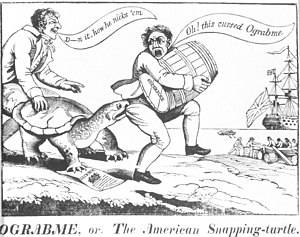
An 1807 political cartoon showing merchants caught by a snapping turtle named "Ograbme" ("Embargo" spelled backwards). The embargo was also ridiculed in the New England press as Dambargo, Mob-Rage, or Go-bar-'em.
The embargo hurt the Us as much as it did U.k. or French republic. Britain, expecting to suffer virtually from the American regulations, built up a new Southward American marketplace for its exports, and the British shipowners were pleased that American competition had been removed by the action of the United states of america government.
Jefferson placed himself in a foreign position with his embargo policy. Though he had so frequently and eloquently argued for as niggling authorities intervention as possible, he now institute himself assuming extraordinary powers in an effort to enforce his policy. The presidential election of 1808 had James Madison defeat Charles Cotesworth Pinckney but showed that the Federalists were regaining strength and helped to convince Jefferson and Madison that the embargo would have to be removed.[17]
Shortly before leaving role in March 1809, Jefferson signed the repeal of the failed Embargo. Despite its unpopular nature, the Embargo Act had some limited unintended benefits, especially as entrepreneurs and workers responded by bringing in fresh capital and labor to New England textile and other manufacturing industries, which lessened America's reliance on the British trade.[eleven] [18]
Repeal [edit]
On March ane, 1809, Congress passed the Not-Intercourse Act. The police enabled the President, once the wars of Europe had concluded, to declare the country sufficiently safe and to allow strange trade with certain nations.[19]
In 1810, the regime was ready to try yet some other tactic of economic coercion, the desperate measure known as Macon's Bill Number 2.[20] The pecker became law on May 1, 1810 and replaced the Non-Intercourse Act. It was an acquittance of the failure of economic pressure to coerce the European powers. Trade with both U.k. and France was at present thrown open up, and the U.s.a. attempted to bargain with the two belligerents. If either power removed its restrictions on American commerce, the US would reapply not-intercourse against the power that had not washed so.
Napoleon quickly took reward of that opportunity. He promised that his Berlin and Milan Decrees would exist repealed, and Madison reinstated non-intercourse confronting U.k. in the fall of 1810. Though Napoleon did not fulfill his promise, the strained Anglo-American relations prevented him from being brought to task for his duplicity.[21]
The attempts of Jefferson and Madison to secure recognition of American neutrality via peaceful means gained a belated success in June 1812, when U.k. finally promised to repeal their 1807 Orders in Council. The British concession was too late since when the news had reached America, the United States had already declared the War of 1812 confronting Britain.
Wartime legislation [edit]
America'southward announcement of war in mid-June 1812 was followed before long by the Enemy Merchandise Act of 1812 on July 6, which employed similar restrictions as previous legislation.[22] it was likewise ineffective and tightened in December 1813 and debated for farther tightening in Dec 1814. After existing embargoes expired with the onset of war, the Embargo Act of 1813 was signed into law Dec 17, 1813.[23] 4 new restrictions were included: an embargo prohibiting all American ships and goods from leaving port, a complete ban on sure commodities customarily produced in the British Empire, a ban against foreign ships trading in American ports unless 75% of the crew were citizens of the ship'due south flag, and a ban on ransoming ships. The Embargo of 1813 was the nation's final peachy trade restriction. Never once more would the Us government cutting off all trade to attain a foreign policy objective.[24] The Human action particularly injure the Northeast since the British kept a tighter occludent on the Due south and thus encouraged American opposition to the administration. To brand his betoken, the Act was not lifted by Madison until after the defeat of Napoleon, and the point was moot.
On February 15, 1815, Madison signed the Enemy Trade Human activity of 1815,[25] which was tighter than any previous merchandise restriction including the Enforcement Human action of 1809 (January 9) and the Embargo of 1813, but it would expire 2 weeks after when official word of peace from Ghent was received.[26] [27]
See besides [edit]
- Bibliography of Thomas Jefferson
- Second-term expletive
References [edit]
- ^ Napoleon's brief return during the "Hundred Days" had no bearing on the United states of america.
- ^ DeToy, Brian (1998). "The Impressment of American Seamen during the Napoleonic Wars". Consortium on Revolutionary Europe 1750–1850: Selected Papers, 1998. Florida State University. pp. 492–501.
- ^ Gilje, Paul A. (Spring 2010). "'Gratuitous Merchandise and Sailors' Rights': The Rhetoric of the War of 1812". Journal of the Early on Democracy. 30 (one): 1–23. doi:ten.1353/jer.0.0130. S2CID 145098188.
- ^ "Embargo of 1807". Monticello and the Thomas Jefferson Foundation. Retrieved Dec 18, 2015.
- ^ Tucker, Spencer C.; Reuter, Frank T. (1996). Injured Accolade: The Chesapeake-Leopard Affair. Naval Plant Press. ISBN1-55750-824-0.
- ^ 2 Stat. 451 (1807) Library of Congress, U.Southward. Congressional Documents and Debates, 1774–1875
- ^ 2 Stat. 379 (1806) Library of Congress, U.S. Congressional Documents and Debates, 1774–1875
- ^ Malone, Dumas (1974). Jefferson the President: The Second Term . Boston: Dark-brown-Little. ISBN0-316-54465-5.
- ^ Irwin, Douglas (September 2005). "The Welfare Toll of Autarky: Evidence from the Jeffersonian Trade Embargo, 1807–09" (PDF). Review of International Economic science. thirteen (4): 631–645. doi:ten.1111/j.1467-9396.2005.00527.x.
- ^ "Thomas Jefferson: The Original Isolationist". The Federalist. September 23, 2013. Retrieved February vii, 2021.
- ^ a b Strum, Harvey (May 1994). "Rhode Island and the Embargo of 1807" (PDF). Rhode Island History. 52 (2): 58–67. ISSN 0035-4619.
Although the state's manufacturers benefited from the embargo, taking advantage of the increased demand for domestically produced goods (especially cotton wool products), and merchants with idle capital were able to move from shipping and trade into manufacturing, this industrial growth did not compensate for the considerable distress that the embargo caused.
- ^ Muller, H. Nicholas Three (Winter 1970). "Smuggling into Canada: How the Champlain Valley Defied Jefferson's Embargo" (PDF). Vermont History. 38 (1): 5–21.
- ^ a b Gordinier, Glenn Stine (January 2001). Versatility in Crisis: The Merchants of the New London Community District Respond to the Embargo of 1807–1809 (PhD dissertation). U. of Connecticut. AAI3004842.
- ^ a b c Adams, Henry (1879). Gallatin to Jefferson, December 1807. The Writings of Albert Gallatin. Vol. 1. Philadelphia: Lippincott.
- ^ two Stat. 453 (1808) Library of Congress, U.Southward. Congressional Documents and Debates, 1774–1875
- ^ "Statutes at Large: Congress 10 | Law Library of Congress". www.loc.gov. September 2014. Retrieved January 15, 2020.
- ^ Tucker, Robert W.; Hendrickson, David C. (1990). "Chapter xx". Empire of Liberty: The Statecraft of Thomas Jefferson . Oxford University Press. ISBN0-19-506207-8.
- ^ Frankel, Jeffrey A. (June 1982). "The 1807–1809 Embargo Against Britain". Journal of Economical History. 42 (2): 291–308. doi:10.1017/S0022050700027443. JSTOR 2120129.
- ^ Heidler, David Stephen; Heidler, Jeanne T., eds. (2004). Encyclopedia of the State of war of 1812. Naval Found Press. pp. 390–91. ISBN978-1-591-14362-8.
- ^ Wills, Garry (2002). James Madison: The fourth President, 1809–1817. The American Presidents Serial. Vol. four. p. 87. ISBN978-0-8050-6905-one.
- ^ Merrill, Dennis; Paterson, Thomas (September 2009). Major Issues in American Strange Relations: To 1920. Cengage Learning. pp. 132–33. ISBN978-0-547-21824-3 . Retrieved Dec 21, 2011.
- ^ "Enemy Trade Act of 1812 ~ P.Fifty. 12-129" (PDF). ii Stat. 778 ~ Affiliate CXXIX. USLaw.Link. July 6, 1812.
- ^ "Embargo Act of 1813 ~ P.50. 13-1" (PDF). 3 Stat. 88 ~ Chapter I. USLaw.Link. December 17, 1813.
- ^ Hickey, Donald R. (1989). "Ch.7: The Terminal Embargo". The War of 1812 – A Forgotten Conflict. pp. 172, 181. ISBN9780252060595.
- ^ "Enemy Trade Human activity of 1815 ~ P.L. 13-31" (PDF). three Stat. 195 ~ Chapter XXXI. USLaw.Link. February 4, 1815.
- ^ Tucker, Spencer C.; Arnold, James R., eds. (2012). The Encyclopedia Of the War Of 1812, a political, social, and war machine history. ABC-CLIO. pp. 221–25. ISBN978-one-85109-956-6.
- ^ "Enforcement Deed of 1809 ~ P.50. x-five" (PDF). ii Stat. 506 ~ Affiliate 5. USLaw.Link. January 9, 1809.
Farther reading [edit]
- Hofstadter, Richard. 1948. The American Political Tradition (Chapter 11) Alfred A. Knopf. in Essays on the Early Republic, 1789–1815 Leonard Levy, Editor. Dryden Press, 1974.
- Irwin, Douglas A. (2005). "The Welfare Cost of Autarky: Evidence from the Jeffersonian Trade Embargo, 1807–09" (PDF). Review of International Economics. 13 (4): 631–45. doi:10.1111/j.1467-9396.2005.00527.10.
- Kaplan, Lawrence South. (1957). "Jefferson, the Napoleonic Wars, and the Balance of Power". William and Mary Quarterly. xiv (two): 196–217. doi:10.2307/1922110. JSTOR 1922110. in Essays on the Early Republic, 1789–1815 Leonard Levy, Editor. Dryden Printing, 1974.
- Levy, Leonard W. (1963). Jefferson and Civil Liberties: The Darker Side. Cambridge: Belknap Press.
- Levy, Leonard. 1974. Essays on the Early Democracy, 1789–1815. Dryden Press, 1974.
- McDonald, Forrest (1976). The Presidency of Thomas Jefferson . Lawrence: Academy Printing of Kansas. ISBN0-7006-0147-3.
- Malone, Dumas (1974). Jefferson the President: The Second Term . Boston: Footling, Brown. ISBN0-316-54465-v.
- Mannix, Richard (1979). "Gallatin, Jefferson, and the Embargo of 1808". Diplomatic History. 3 (2): 151–72. doi:10.1111/j.1467-7709.1979.tb00307.x.
- Muller, H. Nicholas (1970). "Smuggling into Canada: How the Champlain Valley Defied Jefferson's Embargo". Vermont History. 38 (one): 5–21. ISSN 0042-4161.
- Perkins, Bradford. 1968. Embargo: Alternative to War (Affiliate 8 from Prologue to War: England and the Us, 1805–1812, University of California Press, 1968) in Essays on the Early Democracy 1789–1815. Leonard Levy, Editor. Dryden Press, 1974.
- Sears, Louis Martin (1927). Jefferson and the Embargo. Durham: Knuckles University Printing.
- Smelser, Marshall (1968). The Autonomous Commonwealth, 1801–1815. New York: Harper & Row. ISBN0-06-131406-4.
- Smith, Joshua 1000. (1998). "'And so Far Afar from the Eyes of Authority:' Jefferson's Embargo and the U.S. Navy, 1807–1809". In Symonds, Craig (ed.). New Interpretations in Naval History: Selected Papers from the 12th Naval History Symposium. Annapolis, Doctor: Naval Establish Printing. pp. 123–40. ISBN1-55750-624-8.
- Smith, Joshua Thou. (2000). "Murder on Isle au Haut: Violence and Jefferson's Embargo in Littoral Maine, 1808–1809". Maine History. 39 (i): 17–40.
- Smith, Joshua M. (2006). Borderland Smuggling: Patriots, Loyalists, and Illicit Trade in the Northeast, 1783–1820. Gainesville: University Press of Florida. ISBN0-8130-2986-four.
- Spivak, Burton (1979). Jefferson's English Crisis: Commerce, Embargo, and the Republican Revolution. Charlottesville: University Press of Virginia. ISBN0-8139-0805-1.
- Strum, Harvey (1994). "Rhode Island and the Embargo of 1807". Rhode Island History. 52 (2): 58–67. ISSN 0035-4619.
External links [edit]
- The Embargo Human action of 1807 (James Schouler, The Cracking Democracy past the Primary Historians Vol. II, Hubert H. Bancroft and Oliver H. G. Leigh, Ed. (1902)[1897], pp. 335–364)
Source: https://en.wikipedia.org/wiki/Embargo_Act_of_1807
0 Response to "what did thomas jefferson hope to accomplish by passing the embargo act"
Post a Comment