The Phillips Family Southern Gospel J. Charles and Greg Phillips
| Carl Perkins | |
|---|---|
 Perkins in 1977 | |
| Born | Carl Lee Perkins (1932-04-09)April nine, 1932 Tiptonville, Tennessee, U.S. |
| Died | January 19, 1998(1998-01-19) (aged 65) Jackson, Tennessee, U.S. |
| Resting place | Ridgecrest Cemetery Jackson, Tennessee, U.Due south. |
| Occupation |
|
| Musical career | |
| Genres |
|
| Instruments |
|
| Years active | 1946–1997 |
| Labels |
|
| Associated acts |
|
Carl Lee Perkins (April nine, 1932 – January 19, 1998)[1] [ii] was an American singer, songwriter, and guitarist who recorded almost notably at the Lord's day Studio, in Memphis, beginning in 1954. Amid his all-time-known songs are "Blueish Suede Shoes", "Matchbox" and "Everybody's Trying to Be My Baby".
According to Charlie Daniels, "Carl Perkins' songs personified the rockabilly era, and Carl Perkins' sound personifies the rockabilly sound more so than anybody involved in it, considering he never changed."[three] Perkins's songs were recorded by artists (and friends) as influential as Elvis Presley, the Beatles, Jimi Hendrix, Johnny Cash and Eric Clapton which further established his place in the history of popular music. Paul McCartney said "if there were no Carl Perkins, in that location would be no Beatles."[iv]
Called "the Male monarch of Rockabilly", he was inducted into the Rock and Whorl Hall of Fame, the Rockabilly Hall of Fame, the Memphis Music Hall of Fame, and the Nashville Songwriters Hall of Fame. He also received a Grammy Hall of Fame Laurels.
Biography [edit]
Early life [edit]
Perkins was born in Tiptonville, Tennessee, the son of poor sharecroppers Louise and Buck Perkins (misspelled on his birth document as "Perkings").[5] Beginning at the age of six, he worked long hours in the cotton fields with his family, whether school was in session or not.[half-dozen] He grew up hearing southern gospel music sung by white friends in church and by black field workers working in the cotton fields.[7] On Saturday nights Perkins would listen to the K Ole Opry on his father's radio. Roy Acuff'southward broadcasts inspired him to ask his parents for a guitar.[8] Since they could not afford one, his begetter made i from a cigar box and a broomstick. Eventually, a neighbor sold his father a worn-out Gene Autry guitar. Perkins could not afford new strings, and when they broke he had to retie them. The knots cut his fingers when he would slide to some other note, so he began bending the notes, stumbling onto a type of blue note.[3] [9]
Perkins taught himself parts of Acuff's "Great Speckled Bird" and "The Wabash Missive", having heard them played on the Opry. He also cited Bill Monroe's fast playing and vocals every bit an early influence.[10] Perkins also learned from John Westbrook, an African-American field worker in his sixties who played blues and gospel music on an old audio-visual guitar. Westbrook advised Perkins to "Get down close to information technology. Yous can experience information technology travel downwards the strangs, come up through your head and down to your soul where you live. You tin feel information technology. Let information technology vib-a-charge per unit."[three] [9]
In January 1947, the Perkins family moved from Lake County, Tennessee, to Madison Canton. Now in closer proximity to Memphis, Perkins was exposed to a greater variety of music.[11] At age fourteen, he wrote a state song called "Allow Me Have You to the Motion-picture show, Magg". It was that song that eventually persuaded Sam Phillips to sign Perkins to his Sun Records label.[12]
Beginnings as a performer [edit]
Perkins and his brother Jay had their first paying job (in tips) as entertainers at the Cotton Boll tavern on Highway 45, twelve miles south of Jackson, starting on Wed nights during late 1946. Perkins was 14 years one-time. I of the songs they played was an up-tempo country blues shuffle version of Neb Monroe'southward "Blueish Moon of Kentucky". Costless drinks were 1 of the perks of playing in a tavern, and Perkins drank four beers that kickoff night. Inside a month Carl and Jay began playing Fri and Saturday nights at the Sand Ditch tavern, nearly the western boundary of Jackson. Both places were the scene of occasional fights, and both of the Perkins brothers gained a reputation as fighters.[thirteen]
During the next couple of years the Perkins brothers began playing other taverns effectually Bemis and Jackson, including El Rancho, the Roadside Inn, and the Hilltop, equally they became ameliorate known. Carl persuaded his blood brother Clayton to play the upright bass to complete the sound of the band.[fourteen]
Perkins began performing regularly on WTJS in Jackson during the tardily 1940s as a sometime member of the Tennessee Ramblers. He also appeared on Hayloft Frolic, on which he performed ii songs, sometimes including "Talking Blues" as done past Robert Lunn on the Grand Ole Opry. Perkins and so his brothers began actualization on The Early on Morning Farm and Dwelling house Hour. Positive listener response resulted in a xv-minute segment sponsored by Mother's Best Flour. By the cease of the 1940s, the Perkins Brothers were the all-time-known ring in the Jackson surface area.[15] Perkins had mean solar day jobs during most of these early years, including picking cotton fiber, working at diverse factories and plants, and as a pan greaser for the Colonial Baking Company.[sixteen] [17]
In January 1953, Perkins married Valda Crider, whom he had known for a number of years. When his chore at the baker was reduced to office-time, Valda, who had her own chore, encouraged Perkins to brainstorm working the taverns full-time. He began playing 6 nights a week. Later the same year he added W.Due south. "Fluke" Holland to the band as a drummer. Holland had no previous experience every bit a musician merely had a skillful sense of rhythm.[xviii]
Malcolm Yelvington, who remembered the Perkins Brothers when they played in Covington, Tennessee, in 1953, noted that Carl had an unusual blues-like way all his own.[19] By 1955 Perkins had made tapes of his material with a borrowed tape recorder, and he sent them to companies such as Columbia and RCA, with addresses like "Columbia Records, New York City". "I had sent tapes to RCA and Columbia and had never heard a thing from 'em."[20]
In July 1954, Perkins and his wife heard a new release of "Blueish Moon of Kentucky" past Elvis Presley, Scotty Moore and Pecker Black on the radio.[21] As the song faded out, Perkins said, "In that location's a homo in Memphis who understands what nosotros're doing. I need to become see him."[22] According to some other telling of the story, information technology was Valda who told him that he should go to Memphis.[23] Later, Presley told Perkins he traveled to Jackson and had seen Perkins and his group playing at El Rancho.[20]
Years later the musician Cistron Vincent told an interviewer, rather than "Blue Moon of Kentucky" being a "new sound", "a lot of people were doing it before that, peculiarly Carl Perkins."[24]
Sun Records [edit]

Perkins successfully auditioned for Sam Phillips at Sunday Records in early October 1954. "Motion picture Magg" and "Turn Around" were released on the Phillips-owned Flip label (151) on March nineteen, 1955.[25] "Turn Around" became a regional success, and Perkins was booked to appear along with Elvis Presley at theaters in Marianna and West Memphis, Arkansas.[2] [26] Johnny Greenbacks and the Tennessee Two were the side by side musicians to be added to the performances by Sun musicians. During the summertime of 1955 there were junkets to Little Stone and Forrest City, Arkansas and to Corinth and Tupelo, Mississippi. Again performing at El Rancho, the Perkins brothers were involved in an automobile blow in Woodside, Delaware. A friend, who had been driving, was pinned by the steering bicycle and had to be dragged from the called-for car by Perkins. Clayton had been thrown from the car just was not seriously injured.[27]
Another Perkins song, "Gone Gone Gone",[28] [29] released past Sun in October 1955,[thirty] was besides a regional success. Information technology was a "bounciness blues in flavorsome combined state and r.&b. idioms".[31] The B-side was the more than traditional state vocal "Let the Jukebox Keep On Playing".[32]
Commenting on Perkins's playing, Sam Phillips has been quoted as saying, "I knew that Carl could rock and in fact he told me right from the beginning that he had been playing that music before Elvis came out on record ... I wanted to come across whether this was someone who could revolutionize the country stop of the business."[33]
Also in the fall of 1955, Perkins wrote "Bluish Suede Shoes"[vii] later seeing a dancer get angry with his date for scuffing up his shoes.[34] Several weeks later, on Dec 19, 1955, Perkins and his band recorded the song during a session at Sunday Studio in Memphis. Phillips suggested changes to the lyrics ("Get, cat, get"), and the band changed the cease of the song to a "boogie vamp".[35] Presley left Sun Records for RCA in November, and Perkins was left as the main rockabilly artist at Sun. In December that year, Phillips told him, "Carl Perkins, y'all're my rockabilly cat at present."[36] Released on Jan 1, 1956, "Blue Suede Shoes" was a massive nautical chart success. In the United States, it reached number 1 on Billboard magazine's country music chart (the only number 1 success he would have) and number 2 on the Billboard Best Sellers pop music chart. On March 17, Perkins became the outset country artist to reach number 3 on the rhythm and blues charts.[35] [37] That night, Perkins performed the song on ABC-TV's Ozark Jubilee, his goggle box debut (Presley performed it for the second time that same night on CBS-TV'southward Phase Show; he'd first sung it on the program on February eleven).
In the United Kingdom, the song reached number x on the British charts. It was the starting time record by a Sunday artist to sell a one thousand thousand copies. The B side, "Honey Don't", was covered by the Beatles,[7] Wanda Jackson and (in the 1970s) T. Male monarch. John Lennon sang pb on the song when the Beatles performed it, before it was given to Ringo Starr to sing. Lennon as well performed the vocal on the Lost Lennon Tapes.[37]
Road crash [edit]
Subsequently playing a bear witness in Norfolk, Virginia, on March 21, 1956, the Perkins Brothers Band headed to New York Urban center for a March 24 appearance on NBC-Idiot box'due south Perry Como Testify. Shortly earlier sunrise on March 22, on Route 13 betwixt Dover and Woodside, Delaware, their vehicle hit the dorsum of a pickup truck and went into a ditch containing about a human foot of water. Holland had to pull Perkins, unconscious, from the water. Perkins had sustained three fractured vertebrae in his cervix, a severe concussion, a broken collar bone, and lacerations all over his body. Perkins remained unconscious for an entire day. The commuter of the pickup truck, Thomas Phillips, a forty-twelvemonth-one-time farmer, died when he was thrown into the steering cycle.[38] Jay Perkins had a fractured neck and severe internal injuries; complications from these injuries led to a brain tumor, and he died in 1958.[39] [twoscore]
On March 23, Elvis's band members Nib Black, Scotty Moore and D.J. Fontana visited Perkins on their way to New York to appear with Presley. Fontana recalled Perkins proverb, "Yous looked like a bunch of angels coming to meet me."[41] Blackness told him, "Hey human, Elvis sends his honey", and lit a cigarette for him, fifty-fifty though the patient in the next bed was in an oxygen tent.[42] Presley likewise telegraphed Perkins his well wishes.[42]
"Blue Suede Shoes" had sold more than than 500,000 copies by March 22, and Sam Philips had planned to celebrate past presenting Perkins with a golden record on The Perry Como Bear witness.[43] While Perkins recuperated from his injuries, "Blue Suede Shoes" reached number 1 on regional pop, R&B, and country charts. Information technology too reached number two on the Billboard pop and land charts, below Elvis Presley's "Heartbreak Hotel". By mid-Apr, more than i meg copies of "Blue Suede Shoes" had been sold.[44] On Apr 3, while nevertheless recuperating in Jackson, Perkins watched Presley perform "Blue Suede Shoes" on his beginning appearance on The Milton Berle Show, which was his third performance of the vocal on national television.[45] [46]
Return to recording and touring [edit]
Perkins returned to live performances on April 21, 1956, start with an appearance in Beaumont, Texas, with the "Big D Jamboree" bout.[47] Before he resumed touring, Sam Phillips arranged a recording session at Sun, with Ed Cisco filling in for the still-recuperating Jay. By mid-April, "Dixie Fried", "Put Your Cat Wearing apparel On", "Right String, Wrong Yo-Yo", "Yous Can't Brand Dear to Somebody", "Everybody's Trying to Be My Babe", and "That Don't Motility Me" had been recorded.[48]
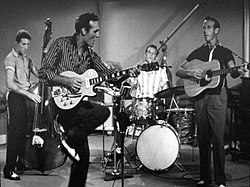
Carl Perkins (2nd from left) performing "Glad All Over" with (left to right) Clayton Perkins, Westward.S. "Fluke" Holland, and Jay Perkins in the moving picture Jamboree
Outset early on that summer, Perkins was paid $1,000 to play just 2 songs a nighttime on the extended tour of "Top Stars of '56". Other performers on the tour were Chuck Drupe and Frankie Lymon and the Teenagers. When Perkins and the group entered the phase in Columbia, Southward Carolina, he was shocked to see a teenager with a bleeding chin pressed against the stage by the crowd. During the start guitar intermission of "Honey Don't" they were waved offstage and into a vacant dressing room behind a double line of police force officers. Appalled by what he had seen and experienced, Perkins left the bout.[49] Appearing with Gene Vincent and Lillian Briggs in a "rock 'n' roll prove", he helped pull 39,872 people to the Reading Fair in Pennsylvania on a Tuesday night in late September. A full grandstand and one k people stood in a heavy rain to hear Perkins and Briggs at the Brockton Fair in Massachusetts.[50]
Sun issued more than Perkins songs in 1956: "Boppin' the Blues"/"All Mama'southward Children" (Sunday 243), the B side co-written with Johnny Greenbacks, and "Dixie Fried"/"I'yard Sad, I'm Not Sorry" (Lord's day 249). "Matchbox"/"Your Truthful Love" (Dominicus 261)[51] came out in February 1957.[30] "Boppin' the Dejection" reached number 47 on the Cashbox pop singles chart, number 9 on the Billboard country and western chart, and number seventy on the Billboard Top 100 nautical chart.
"Matchbox" is considered a rockabilly archetype. It was recorded during an impromptu session with Perkins, Presley, Johnny Cash, and Jerry Lee Lewis, informally referred to as the Million Dollar Quartet.[seven] The full recordings from this session, a selection of gospel, state, and R&B songs, were released in 1990.[ii]
On Feb 2, 1957, Perkins over again appeared on Ozark Jubilee, singing "Matchbox" and "Bluish Suede Shoes". He too made at least two appearances on Town Hall Party in Compton, California, in 1957,[52] singing both songs. Those performances were included in the Western Ranch Dance Political party series filmed and distributed by Screen Gems.
He released "That's Right", co-written with Johnny Cash, backed with the ballad "Forever Yours", as Sun single 274 in August 1957. Neither side made information technology onto the charts.
The 1957 film Jamboree included a Perkins performance of "Glad All Over". The song, written by Aaron Schroeder, Sid Tepper, and Roy C. Bennett,[53] was released by Sun in Jan 1958.[54]
Life later on Sunday [edit]
In 1958, Perkins moved to Columbia Records, for which he recorded "Jive Later Five", "Rockin' Tape Hop", "Levi Jacket (And a Long Tail Shirt)", "Pop, Let Me Take the Car", "Pink Pedal Pushers", "Whatsoever Way the Air current Blows", "Hambone", "Pointed Toe Shoes", "Sister Twister", "L-O-V-East-Five-I-Fifty-L-E" and other songs.[30]
In 1959, he wrote the state-and-western song "The Carol of Kicking Hill" for Johnny Cash, who recorded it on an EP for Columbia Records. In the same year, Perkins was cast in a Filipino movie produced by People's Pictures, Hawaiian Boy, in which he sang "Blue Suede Shoes".[ citation needed ]
He performed often at the Gilt Nugget Casino in Las Vegas in 1962 and 1963. During this time he toured nine Midwestern states and made a bout in Deutschland.
In May 1964, Perkins toured United kingdom with Chuck Berry.[55] Perkins had been reluctant to undertake the tour, convinced that equally forgotten equally he was in America, he would be even more obscure in the U.Grand., and he did non want to be humiliated past drawing meager audiences. Berry assured him that they had remained much more pop in United kingdom of great britain and northern ireland since the 1950s than they had in the United states of america and that there would exist big crowds of fans at every show. The Animals backed the ii performers. On the last night of the bout, Perkins attended a party where he sat on the floor sharing stories, playing guitar, and singing songs while surrounded past the Beatles. Ringo Starr asked if he could record "Dearest Don't". Perkins answered, "Man, go ahead, take at it."[56] The Beatles went on to record covers of "Matchbox", "Dear Don't" and "Everybody'southward Trying to Be My Baby" (recorded past Perkins, adapted from a song originally recorded by King Griffin in 1936, with new music by Perkins; a song with the same title was recorded past Roy Newman in 1938). The Beatles recorded 2 versions of "Glad All Over" in 1963.[57] Another bout to Federal republic of germany followed in the autumn.
He released "Big Bad Blues" backed with "Lonely Heart" every bit a single on Brunswick Records with the Nashville Teens in June 1964.[58]
In 1966, Perkins signed with Dollie Records and released as his outset single "Country Boy'southward Dream" which reached #22 in the country charts.
While on tour with the Johnny Cash troupe in 1968, Perkins went on a four-solar day drinking binge that ended in him hallucinating floridly and passing out. When he regained consciousness, he went out to the beach with his terminal bottle of alcohol. In his autobiography, he described falling to his knees and declaring, "Lord, ... I'm gonna throw this bottle. I'm gonna evidence Yous that I believe in you," earlier hurling the bottle into the sea and vowing to remain sober. Perkins and Cash, who had his own substance-abuse issues, supported each other in their bid to remain sober.[59]
In 1968, Cash recorded the Perkins-written "Daddy Sang Bass" (which incorporates parts of the American standard "Will the Circumvolve Be Unbroken") and scored No. one on the land music charts for six weeks. "Daddy Sang Bass" was a Country Music Association nominee for Vocal of the Year. Perkins too played pb guitar on Cash'southward single "A Male child Named Sue", recorded alive at San Quentin prison, which went to No. i for five weeks on the country chart and No. 2 on the popular chart (the performance was also filmed past Granada Television for broadcast). Perkins spent a decade in Cash'south touring revue, often as an opening deed for Cash (as at the Folsom and San Quentin prison concerts, at which he was recorded singing "Blueish Suede Shoes" and "Matchbox" before Greenbacks took the stage; these performances were not released until the 2000s). He also appeared on the boob tube seriesThe Johnny Greenbacks Show.
On the television programme Kraft Music Hall on April xvi, 1969, hosted past Cash, Perkins performed his song "Restless".[60] [61]
Perkins and Bob Dylan wrote "Champaign, Illinois" in 1969. Dylan was recording in Nashville from February 12 to February 21 for his album Nashville Skyline. He met Perkins when he appeared on The Johnny Cash Show on June 7.[62] Dylan had writer'due south block and was unable to complete the song until Perkins contributed a rhythm and some lyrics, upon which Dylan said to him, "Your vocal. Have it. Cease it."[63] The co-authored song was included on Perkins'south 1969 anthology On Top.[64] [65]
Perkins was too united in 1969 by Columbia's Murray Krugman with a rockabilly group based in New York's Hudson Valley, the New Rhythm and Dejection Quartet. Perkins and NRBQ recorded Boppin' the Dejection, which featured the group backing him on songs including his staples "Turn Effectually" and "Boppin' the Blues" and included songs recorded separately by Perkins and NRBQ.[66] One of his Boob tube appearances with Cash was on the pop land series Hee Haw, on February 16, 1974.
Tommy Cash (brother of Johnny Cash) had a Top Ten country gospel hit in 1970 with a recording of the vocal "Ascension and Polish", written by Perkins. It reached number 9 on the Billboard country nautical chart and number viii on the Canadian state chart. Arlene Harden had a Height forty country hitting in 1971 with the Perkins composition "True Love Is Greater Than Friendship", from the picture show Fiddling Fauss and Big Halsy (1971), which reached number 22 on the Billboard country chart and number 33 on the Billboard Adult Contemporary chart for Al Martino that same twelvemonth.
After a long legal struggle with Sam Phillips over royalties, Perkins gained ownership of his songs in the 1970s.[67]
Afterwards years [edit]
The rockabilly revival of the 1980s helped bring Perkins dorsum into the limelight. In 1981 Perkins recorded the song "Get Information technology" with Paul McCartney, providing vocals and playing guitar with the erstwhile Beatle; co-ordinate to one source, he fully co-wrote the vocal with McCartney.[68] This recording was included on the nautical chart-topping album Tug of War, released in 1982.[69] During 1985, he re-recorded "Blue Suede Shoes" with Lee Rocker and Slim Jim Phantom of the Stray Cats, as office of the soundtrack for the film Porky's Revenge.
In October 1985, George Harrison, Eric Clapton, Dave Edmunds, Lee Rocker, Rosanne Cash and Ringo Starr appeared with him on stage for a television special, Bluish Suede Shoes: A Rockabilly Session, which was taped live at the Limehouse Studios in London. The evidence was shown on Aqueduct 4 on January 1, 1986. Perkins performed 16 songs, with 2 encores, in an extraordinary operation. He and his friends ended the session by singing his almost famous song, xxx years after its writing, which brought Perkins to tears. The concert special was a highlight of his later career and has been praised by fans for the spirited performances delivered by Perkins and his guests. The concert was released for DVD by Snapper Music in 2006.[70]
Perkins was inducted into the Nashville Songwriters Hall of Fame in 1985. Wider recognition of his contribution to music came with his consecration into the Stone and Roll Hall of Fame in 1987. "Bluish Suede Shoes" was chosen as one of the Stone and Whorl Hall of Fame'southward "500 Songs That Shaped Rock and Scroll". The vocal also received a Grammy Hall of Fame Laurels. Perkins was inducted into the Rockabilly Hall of Fame in recognition of his pioneering contribution to the genre.
Perkins'south only notable film performance equally an histrion was in John Landis'due south 1985 movie Into the Night, a cameo-laden film that includes a scene in which characters played by Perkins and David Bowie die by each other'south hand.[71]
Perkins returned to the Sun Studio in Memphis in 1986, joining Cash, Jerry Lee Lewis and Roy Orbison on the album Class of '55. The record was a tribute to their early on years at Sun and, specifically, the Meg Dollar Quartet jam session involving Perkins, Presley, Greenbacks, and Lewis in 1956.
In 1989, Perkins co-wrote and played guitar on the Judds' number 1 country hitting, "Allow Me Tell You lot About Love". As well in that year, he signed a tape deal with Platinum Records for the anthology Friends, Family, and Legends, featuring performances by Chet Atkins, Travis Tritt, Steve Wariner, Joan Jett and Charlie Daniels, along with Paul Shaffer and Will Lee. During the production of this album, Perkins developed pharynx cancer.
He again returned to Sun Studio to record with Scotty Moore, Presley's first guitar player, for the album 706 ReUNION, released by Belle Meade Records, which also featured D. J. Fontana, Marcus Van Storey and the Jordanaires. In 1993, Perkins performed with the Kentucky Headhunters in a music video remake of his song "Dixie Fried", filmed in Glasgow, Kentucky. In 1994, he teamed up with Duane Eddy and the Mavericks to contribute "Matchbox" to the AIDS benefit anthology Red Hot + State, produced past the Cerise Hot Organization.
His concluding album, Go Cat Go!, released by the independent label Dinosaur Records in 1996, features Perkins singing duets with Bono, Johnny Cash, John Fogerty, George Harrison, Paul McCartney, Willie Nelson, Tom Petty, Paul Simon, and Ringo Starr.[72] [73]
His last major concert performance was the Music for Montserrat all-star clemency concert at London's Royal Albert Hall on September 15, 1997, 4 months before his expiry.
Personal life [edit]
A strong advocate for the prevention of kid abuse, Perkins worked with the Jackson Exchange Lodge to establish the first eye for the prevention of child abuse in Tennessee and the fourth in the nation. Gain from a concert planned by Perkins were combined with a grant from the National Exchange Club to plant the Prevention of Child Corruption in October 1981. For years its annual Circumvolve of Hope Telethon generated one quarter of the center's annual operating upkeep.[74]
Perkins had one daughter, Debbie, and 3 sons, Stan, Greg, and Steve.
Stan, his first-built-in son, is as well a recording artist. In 2010, he joined forces with Jerry Naylor to record a duet tribute, "To Carl: Allow it Vibrate". Stan has been inducted into the Rockabilly Hall of Fame.
Perkins died on Jan nineteen, 1998, at the age of 65 at Jackson-Madison County Hospital in Jackson, Tennessee, from throat cancer. He had suffered several pocket-size strokes the previous month. Amidst the mourners at his funeral at Lambuth University were George Harrison, Jerry Lee Lewis, Wynonna Judd, Garth Brooks, Nashville amanuensis Jim Dallas Crouch, Johnny Cash and June Carter Cash. Perkins was interred at Ridgecrest Cemetery in Jackson.
Perkins's widow, Valda deVere Perkins, died on November 15, 2005, in Jackson.
Guitar style [edit]
Equally a guitarist Perkins used finger picking, imitations of the pedal steel guitar, palm muting, arpeggios, advantageous use of open up strings, single and double string bending, chromaticism, country and blues licks, and tritone and other tonality clashing licks (short phrases that include notes from other keys and move in logical, often symmetric patterns).[75] A rich vocabulary of chords including 6th and thirteenth chords, ninth and add ix chords, and suspensions, show upward in rhythm parts and solos. Free use of syncopations, chord anticipations (arriving at a chord modify before the other players, often by an eighth-annotation) and crosspicking (repeating a three 8th-note pattern so that an emphasis falls variously on the upbeat or downbeat) were besides in his handbag of tricks.[76]
Legacy [edit]
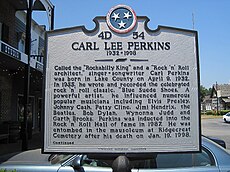
Historic marker commemorating Perkins alongside other famous peers

Continuation of the celebrated placard in tribute to Perkins
Perkins wrote his autobiography, Go, Cat, Go, published in 1996, in collaboration with music writer David McGee in 1996. Plans for a biographical film were appear by Santa Monica-based production company Fastlane Entertainment.[77] [78] was slated for release in 2009.
In 2004, Rolling Rock ranked Perkins number 99 on its list of the 100 Greatest Artists of All Fourth dimension.[79]
Many of the Beatles' alive shows were full of Rock 'Northward' Scroll covers of Carl Perkins's songs such as 'Everybody'southward Trying To Be My Babe', 'Matchbox' and 'Honey Don't'.
His version of "Blue Suede Shoes" was included past the National Recording Preservation Board in the National Recording Registry of the Library of Congress in 2006.[lxxx]
The Perkins family still owns his songs.[67]
Drive-By Truckers, on their album The Dirty South, recorded a song about him, "Carl Perkins' Cadillac". The Carl Perkins Arena in Jackson, Tennessee, is named in his honor.
George Thorogood and the Destroyers covered "Dixie Fried" on their 1985 album Maverick. The Kentucky Headhunters as well covered the song, equally did Keith de Groot on his 1968 album No Introduction Necessary, with Jimmy Page on lead guitar and John Paul Jones on bass.[81]
Ricky Nelson covered Perkins'due south "Boppin' the Blues" and "Your True Love" on his 1957 debut album, Ricky.
Perkins was portrayed by Johnny "Child Memphis" Holiday in the 2005 Johnny Cash biopic Walk the Line.
Perkins was honored with the "Lifetime Accomplishment" honour during the Tennessee Music Awards outcome in 2018 at the University of Memphis Lambuth in Jackson, Tennessee.
Awards [edit]
![[icon]](https://upload.wikimedia.org/wikipedia/commons/thumb/1/1c/Wiki_letter_w_cropped.svg/20px-Wiki_letter_w_cropped.svg.png) | This department needs expansion. You can help by calculation to information technology. (August 2014) |
The following recording by Carl Perkins was inducted into the Grammy Hall of Fame, which is a special Grammy award established in 1973 to honor recordings that are at least 25 years old and that have "qualitative or historical significance".
| Carl Perkins: Grammy Hall of Fame Awards [82] | |||||
| Year Released | Title | Genre | Label | Year Inducted | Notes |
|---|---|---|---|---|---|
| 1956 | "Blueish Suede Shoes" | Rock and Roll (unmarried) | Sun Records | 1986 | |
Discography [edit]
Studio albums [edit]
- Trip the light fantastic toe Album (1957)
- Whole Lotta Shakin' (1958)
- Country Boy'due south Dream (1967)
- On Top (Columbia, 1969)
- My Kind of Land (Mercury, 1973)
- Ol' Blue Suede's Back (1978)
- Land Soul (1979)
- Disciple in Blue Suede Shoes (1984)
- Built-in to Stone (1989)
- Friends, Family & Legends (1992)
Collaborative albums [edit]
- Boppin' the Blues (1970, with NRBQ)
- The Survivors (1982, with Jerry Lee Lewis, and Johnny Cash)
- Grade of '55 (1986, with Roy Orbison, Jerry Lee Lewis, and Johnny Cash)
- The Million Dollar Quartet (1990, with Elvis Presley, Jerry Lee Lewis, and Johnny Cash)
- 706 Re-Union (1990, with Scotty Moore)
- Carl Perkins & Sons (1993, with his sons Greg and Stan)
- Go True cat Go! (1996, with various guest stars)
Alive albums [edit]
- The Carl Perkins Bear witness (1976)
- Live at Austin City Limits (1981)
- The Silver Eagle Cantankerous Country: Carl Perkins Alive (1997)
- Live at Gilley's (1999)
- Alive (2000)
- Blue Suede Shoes: A Rockabilly Session (2006)
Religious albums [edit]
- Rock 'Northward Gospel (1979)
- Pikestaff Creek Glory Church (1979)
- Gospel (1984)
Selected compilations [edit]
- Carl Perkins' Greatest Hits (1969, re-recordings)
- Original Golden Hits (1969)
- Mr. Country Rock (Demand, 1977)
- That Rockin' Guitar Human (1981)
- Presenting Carl Perkins (Accord, 1982)
- Every Road (Joker, 1982)
- Goin' Back to Memphis (Joker, 1982)
- Boppin' the New Bleus (1982)
- Built-in to Boogie (O'Hara Records, 1982)
- This Ole House (1982)
- Presenting (1982)
- The Eye and Soul of Carl Perkins (Fidelity, 1983)
- Carl Perkins (Dot, 1985)
- Original Lord's day Greatest Hits (1986)
- Up Through the Years 1954–57 (1986)
- Country Boy's Dream - The Dollie Masters (Comport Family, 1991)
- Accept Me Dorsum (1993)
- Back on Top - (Conduct Family, 2000; four CDs, comprising 1968–1975)
Guest appearances [edit]
- Judds: Greatest Hits Volume II (1991)
- Philip Claypool: Perfect World (1999)
Charted albums [edit]
| Year | Album | Peak positions | Label |
|---|---|---|---|
| U.s.a. Land | |||
| 1969 | Carl Perkins' Greatest Hits (re-recordings) | 32 | Columbia |
| On Top | 42 | ||
| Original Gilt Hits | 43 | Sun | |
| 1973 | My Kind of State | 48 | Mercury |
| 1982 | The Survivors Live (with Johnny Cash and Jerry Lee Lewis) | 21 | Columbia |
| 1986 | Grade of '55 (with Jerry Lee Lewis, Roy Orbison and Johnny Cash) | 15 | America/Mercury |
Charted singles [edit]
| Twelvemonth | Single | Peak nautical chart positions | Album | ||
|---|---|---|---|---|---|
| US Country | US | Can State | |||
| 1956 | "Blue Suede Shoes" | 1 | 2 | — | Trip the light fantastic Album of ... Carl Perkins |
| "Boppin' the Blues" | vii | 70 | — | ||
| "Dixie Fried" | 10 | — | — | Original Golden Hits | |
| "I'thou Sad, I'thousand Not Sad" | flip | — | — | Blueish Suede Shoes | |
| 1957 | "Your True Love" | thirteen | 67 | — | Trip the light fantastic Album of ... Carl Perkins |
| 1958 | "Pink Pedal Pushers" | 17 | 91 | — | The Male monarch of Stone |
| 1959 | "Pointed Toe Shoes" | — | 93 | — | |
| 1966 | "Country Male child's Dream" | 22 | — | — | State Boy'due south Dream |
| 1967 | "Shine, Shine, Smooth" | 40 | — | — | |
| 1969 | "Restless" | twenty | — | — | Carl Perkins' Greatest Hits |
| 1971 | "Me Without Yous" | 65 | — | — | The Man Behind Johnny Cash |
| "Cotton fiber Top" | 53 | — | — | ||
| 1972 | "High on Love" | sixty | — | — | Unmarried merely |
| 1973 | "(Permit's Get) Dixiefried" (1973 version) | 61 | — | — | My Kind of Country |
| 1986 | "Nascence of Rock and Curl" | 31 | — | 44 | Course of '55 |
| 1987 | "Class of '55" | 83 | — | — | |
| 1989 | "Charlene" | — | — | 74 | Built-in to Rock |
Billboard Year-Terminate performances [edit]
Notes [edit]
- ^ "Carl Perkins – American musician and songwriter". britannica.com . Retrieved November 9, 2019.
- ^ a b c Pareles.
- ^ a b c Naylor, p. 118.
- ^ "Rock 'due north Curlicue Legend Carl Perkins' Much Anticipated Story to Come to the Big Screen". August 16, 2007. Retrieved Apr 5, 2013.
- ^ [1] Archived Feb 26, 2010, at the Wayback Machine
- ^ Perkins, pp. eight–9.
- ^ a b c d Carl Perkins interviewed on the Popular Chronicles (1969)
- ^ Naylor.
- ^ a b Perkins, pp. 13–xiv.
- ^ Perkins, pp. 11–12.
- ^ Perkins, pp. 30, 55.
- ^ Perkins, pp. 30, 68.
- ^ Perkins, pp. 36–41.
- ^ Perkins, p. 48.
- ^ Perkins, pp. 48–49.
- ^ Perkins, pp. 32, seventy–71.
- ^ "The Fable Carl Perkins". Rockabillytennessee.com. January 19, 1998. Archived from the original on November 17, 2011. Retrieved November 25, 2011.
- ^ Perkins, pp. 70–71.
- ^ Perkins, p. 77.
- ^ a b "The Top Beats the Bottom: Carl Perkins and his Music". The Atlantic. December 1970. p. 100.
- ^ [two] [ dead link ]
- ^ Perkins, pp. 79–xc.
- ^ Rockabilly Legends. Naler. p. 121.
- ^ VanHecke, Susan (2000). Race with the Devil. St. Martin'southward Press. p. 219. ISBN 0-312-26222-ane.
- ^ "Archived copy". Archived from the original on July 13, 2012. Retrieved May 22, 2014.
{{cite web}}: CS1 maint: archived re-create every bit championship (link) - ^ Perkins, pp. 106–108.
- ^ Perkins, pp. 122–124.
- ^ [three] [ dead link ]
- ^ "MP3 recording" (MP3). Rcs-discography.com. Retrieved August 17, 2015.
- ^ a b c "Archived copy". Archived from the original on July 17, 2012. Retrieved May 22, 2014.
{{cite web}}: CS1 maint: archived copy every bit title (link) - ^ Billboard, October 22, 1955. Reviews of New C&Due west Records. p. 44.
- ^ The Carl Perkins Sun collection.
- ^ Escott, Colin; Hawkins, Martin. Adept Rockin' Tonight: Lord's day Records and the Birth of Rock 'n' Gyre. Google eBook. Retrieved 10.11.2011.
- ^ Perrkins, Carl; McGee, David (1996). Get, True cat, Become! Hyperion Press. p. 129. ISBN 0-7868-6073-i
- ^ a b Miller, James (1999). Flowers in the Dustbin: The Rise of Stone and Roll, 1947–1977. Simon & Schuster. pp. 124–25. ISBN 0-684-80873-0.
- ^ Naylor, p. 135.
- ^ a b Naylor, p. 137.
- ^ Perkins, pp. 178, 180.
- ^ Morrison, Craig (1999). Get Cat Go!: Rockabilly Music and Its Makers. University of Illinois Press. p. 83. ISBN978-0-252-06538-5.
- ^ Larkin, Colin (May 27, 2011). The Encyclopedia of Popular Music. Omnibus Press. p. 1988. ISBN978-0-85712-595-viii.
- ^ Burke, Ken; Griffin, Dan (2006). The Blue Moon Boys: The Story of Elvis Presley's Band. Chicago Review Press. p. 88. ISBN 1-55652-614-8.
- ^ a b Perkins, pp. 182, 184.
- ^ Perkins, p. 173.
- ^ Perkins, p. 187.
- ^ Perkins, p. 184.
- ^ "Elvis's Television Appearances 1956–1973". Kki.pl. Archived from the original on July eighteen, 2011. Retrieved 2011-eleven-25 .
- ^ Perkins, p. 191.
- ^ Perkins, p. 198.
- ^ Perkins, pp. 188, 210, 212.
- ^ Billboard September 29, 1956. pages 73, 78.
- ^ [4] Archived February five, 2009, at the Wayback Machine
- ^ "Town Hall Party". hillbilly-music.com. Retrieved November 25, 2011.
- ^ [5] [ dead link ]
- ^ [six] Archived July 17, 2012, at annal.today
- ^ "Bout Information 1964". Chuckberry.de. Retrieved November 25, 2011.
- ^ Naylor, p. 142.
- ^ The Beatles "Glad All Over". "The Beatles Lyrics - Glad All Over". Oldielyrics.com. Retrieved November 25, 2011.
- ^ "Carl Perkins - Big Bad Blues / Lonely Heart - Brunswick - Great britain - 05909". 45cat. Retrieved August 17, 2015.
- ^ Perkins, pp. 309–310.
- ^ "Restless - Carl Perkins". Rockabillyeurope.com. Archived from the original on September 29, 2011. Retrieved November 25, 2011.
- ^ "Kraft Music Hall: Johnny Greenbacks ... On The Road Episode Summary". TV.com. Retrieved November 25, 2011.
- ^ "The Johnny Cash Prove Season ii Episode Guide". TV.com. Retrieved November 25, 2011.
- ^ Perkins.
- ^ "RAB Hall of Fame: Carl Perkins". Rockabilly Hall of Fame. Retrieved January eighteen, 2007.
- ^ "On Acme: Carl Perkins". AOL Music. Archived from the original on July 17, 2012. Retrieved Jan eighteen, 2007.
- ^ Boppin' the Blues. Columbia CS9981 (1969).
- ^ a b Mike Kovacich (April 17, 2003). "MACCA-News: McCartney to Administer Perkins's Music". Macca-central.com. Retrieved November 25, 2011.
- ^ Naylor, p. 145.
- ^ "Tug Of War". Jpgr.co.united kingdom of great britain and northern ireland. Retrieved November 25, 2011.
- ^ DVD Carl Perkins & Friends. Released past Graham Nolder/Snapper Music. 2006. Cat:SDVD514
- ^ "Into the Night (1985): Full Cast & Crew". IMDb.com. Retrieved August 17, 2015.
- ^ "Carl Perkins/Diverse Artists: Get Cat Become!". Theband.hiof.no. Retrieved November 25, 2011.
- ^ [7] [ dead link ]
- ^ Tennessee Historical Committee
- ^ "Pentatonics" (PDF). Paul-clark.com. Archived from the original (PDF) on January 16, 2016. Retrieved Baronial 17, 2015.
- ^ Perkins, p. 78.
- ^ "The Carl Perkins Story". Billboardpublicitywire.com. Archived from the original on April thirteen, 2008. Retrieved November 25, 2011.
- ^ "Rock 'N Curlicue Legend Carl Perkins's Much Anticipated Story To Come To The Big Screen". Billboard Publicity Wire. Archived from the original on April thirteen, 2008.
- ^ "The Immortals: The Commencement Fifty". Rolling Stone. No. 946. Archived from the original on March 16, 2006.
- ^ "2006 National Recording Registry choices". Loc.gov. May 13, 2011. Retrieved November 25, 2011.
- ^ "George Thorogood & The Destroyers Albums". Softshoe-slim.com. Retrieved November 25, 2011.
- ^ "Grammy Hall Of Fame". Grammy.org. Archived from the original on January 22, 2011. Retrieved 2015-08-17 .
References [edit]
- Guterman, Jimmy. (1998.) "Carl Perkins". The Encyclopedia of Country Music. Paul Kingsbury, ed. New York: Oxford Academy Printing. pp. 412–413.
- Pareles, Jon (January twenty, 1998). "Carl Perkins Dies at 65; Rockabilly Pioneer Wrote 'Blue Suede Shoes'". New York Times. p. B12. Retrieved December 4, 2009.
- Perkins, Carl; McGee, David (1996). Go, True cat, Get!. New York: Hyperion Printing. ISBN0-7868-6073-1. OCLC 32895064. .
External links [edit]
- The Carl Perkins Story at IMDb
- Carl Perkins biography
- Perkins's page at the Rockabilly Hall of Fame
- Carl Perkins bio at Rolling Stone
- Carl Perkins Biography at The History of Rock
Source: https://en.wikipedia.org/wiki/Carl_Perkins
0 Response to "The Phillips Family Southern Gospel J. Charles and Greg Phillips"
Post a Comment